Florida’s New Memory Care License: What Families Should Know
Florida is about to change how memory care works in assisted living. A new state law creates a separate memory care services license, and every assisted living facility that cares for residents with Alzheimer’s disease or other dementias, or that advertises memory care, will need one. The state agency that regulates assisted living is now writing the detailed rules. Here is what families should know: who wrote the law, who pushed for it, who benefits, how other states handle memory care, what could go wrong, and whether the change is needed at all.
What the law does
The law began as Senate Bill 1404 in the 2026 legislative session. It passed the Senate 37–0 and the House 111–0, was approved by Governor Ron DeSantis on May 22, 2026, and became Chapter 2026-102, Laws of Florida (now section 429.076, Florida Statutes). In short:
- Any assisted living facility that serves memory care residents, or advertises or “holds itself out” as providing memory care, must hold the new specialty license.
- Facilities without the license may not use terms such as “memory care,” “dementia care” or “Alzheimer’s care” in their advertising.
- Facilities that offer only general supportive services, available to all residents, do not need the license.
- The Agency for Health Care Administration (AHCA) must adopt detailed standards by June 1, 2027, covering policies, admission criteria, minimum care and activities, staff training, safety (including at least one awake staff member at all hours), the physical building and resident contracts.
- Facilities already licensed will have six months after the rules take effect to obtain the new license.
- A narrow exception lets a facility that cannot reasonably get the license keep its existing memory care residents, but it must tell them, help them find another home if they ask, and stop admitting new memory care residents.
Who wrote and sponsored the bill
The Senate sponsor was Sen. Colleen Burton (R-Lakeland), chair of the Senate Health Policy Committee. The House companion, HB 1295, was sponsored by the House Health Care Facilities & Systems Subcommittee and Rep. Sam Greco, with Reps. Chaney, J. López and Valdés as co-introducers. The House ultimately passed the Senate version.
The idea was not new. In 2025, Rep. Mike Redondo (R-Miami) carried HB 493, an earlier attempt to set memory care standards, which advanced in committee but did not become law. Sen. Burton has described the goal simply: today there is no uniform definition of what “memory care” means, so families have a hard time knowing what they are actually getting.
Which lobby groups or lobbyists promoted it?
This is harder to answer than it should be. Florida lobbyists must register the clients they represent, but they are not required to disclose which specific bills they lobby on, and the Legislature’s public bill pages for SB 1404 list no appearance records of supporters or opponents. What the public record does show:
- The state’s own regulator supported the concept. When the 2025 version was heard, AHCA’s deputy secretary testified in favor, saying it would add needed protections and that roughly a quarter to a third of Florida’s approximately 3,000 assisted living facilities claim to offer memory care.
- The largest assisted living trade group had concerns. The Florida Senior Living Association opposed the 2025 version as written. It supported awake, CPR-trained staff and better transparency, but warned that vague definitions could sweep in residents with only mild memory issues.
- Industry groups are shaping the rules. Since the law passed, several trade associations have said publicly that they have shared proposed rule language with AHCA.
We could not find any published record naming a specific lobbyist or firm as the driving force behind the 2026 bill, and we won’t guess. Unanimous votes in both chambers suggest the bill had little organized opposition by the time it passed.
Who benefits most?
- Families, in theory. A single license with clear standards should make it easier to compare options and trust that “memory care” means something specific.
- Regulators. AHCA gains clearer authority over facilities that advertise memory care, something it said it lacked.
- Large operators. Big communities with dedicated memory care wings, compliance staff and the scale to absorb new staffing and building requirements are best positioned. Fewer competitors may be able to use the words “memory care” at all.
- Consultants and attorneys who help facilities navigate licensing, rulemaking and property sales.
Those likely to bear the heaviest burden are small, home-style facilities, the very settings many families choose because they feel like home rather than an institution.
Do other states do this?
Florida is joining a small group of states that require something beyond a basic assisted living license for memory care, though the approaches differ:
- Texas requires an “Alzheimer’s certificate” for assisted living facilities, or distinct units, that advertise specialized Alzheimer’s care.
- Minnesota has had a separate “assisted living facility with dementia care” license since August 2021, with added staffing, training and fees.
- Washington passed a 2025 law requiring memory care certification for facilities with secured units or that market memory care, including 24-hour awake staffing and dementia-specific training.
- Oregon requires a memory care endorsement for facilities that provide memory care.
- Many other states, including Illinois, rely mainly on disclosure laws, which require facilities that advertise Alzheimer’s care to tell families exactly what they provide, rather than a separate license.
What problems are we likely to see?
The law leaves most of the details to AHCA, and the agency’s draft rule text has raised real questions. The draft, which is still subject to change, currently includes:
- A staffing ratio of at least one direct care staff member for every five memory care residents at all times, day and night, with staff required to stay awake.
- No small-facility exception. Current Florida rules let homes with fewer than 17 residents use monitoring systems instead of awake overnight staff. The draft does not carry that exception forward.
- New paperwork, including service plans within 14 days, quarterly reviews with families, monthly progress reports, documented visual rounds and fluids offered every two hours.
- At least 20 hours a week of structured, dementia-specific activities, plus building and outdoor-space standards.
Many of these are good practices. The concern is cost and access:
- Higher costs for added night staff, training and building changes, which families are likely to feel.
- Fewer choices if small homes decide it is not worth getting the license and stop accepting residents with dementia, especially in rural areas.
- Disruption for current residents in facilities that cannot or will not get the license.
- Gray areas. When does a resident with mild memory loss become a “memory care resident”? What counts as “holding out” in advertising? How will Medicaid rates keep up with higher costs?
- Tight timelines for facilities to apply, renovate and train staff within six months of the final rules.
Is this regulatory change even necessary?
Reasonable people disagree. Supporters point out that “memory care” has had no legal definition in Florida. Under current law, a facility that advertises dementia care must disclose its services, train its staff and offer appropriate activities, but the requirements are thin and, as the Senate’s own analysis noted, quality can vary widely. Families deserve to know that the words on a brochure mean something.
Critics respond that Florida already had tools to address bad actors: required dementia training, disclosure rules and AHCA inspections. They argue the state could have strengthened enforcement and transparency instead of adding a new license layer that may raise costs and squeeze out small providers, and that the final rules should be judged on outcomes for residents, not paperwork.
Our view: clear standards for memory care are a good thing for families, and we welcome them. We already keep caregivers on duty around the clock, with an awake caregiver throughout the night. But the rules should be written with smaller, home-style settings in mind, so families don’t lose the option of a quieter, more personal place for someone they love.
What happens next
AHCA has scheduled a public meeting on the new rule for November 17, 2026, from 1 to 2 p.m. at its Tallahassee offices (2727 Mahan Drive). The agency must adopt final rules by June 1, 2027. Families, caregivers and providers can follow the rule, 59A-36.0225, on the AHCA rulemaking page and share comments during the process.
If you’re touring memory care for a loved one, ask every home whether it plans to obtain the new license, how it staffs nights, and how it will handle the transition.
Sources
- Florida Senate: CS/CS/SB 1404 (2026), Memory Care
- Florida Senate: HB 1295 (2026), Memory Care
- Florida Senate bill analysis, SB 1404
- Florida Administrative Register: Rule 59A-36.0225, Memory Care Services
- AHCA draft rule text, 59A-36.0225
- Florida Politics: Bill to establish standards for memory care services advances (2025)
- National Law Review: Florida adopts statute requiring memory care ALFs to obtain license
- Akerman: Florida’s new memory care services specialty license
- Texas Administrative Code: Alzheimer’s certification
- ArentFox Schiff: Washington’s new memory care certification rules
- Dorsey: Minnesota enacts new assisted living facility law
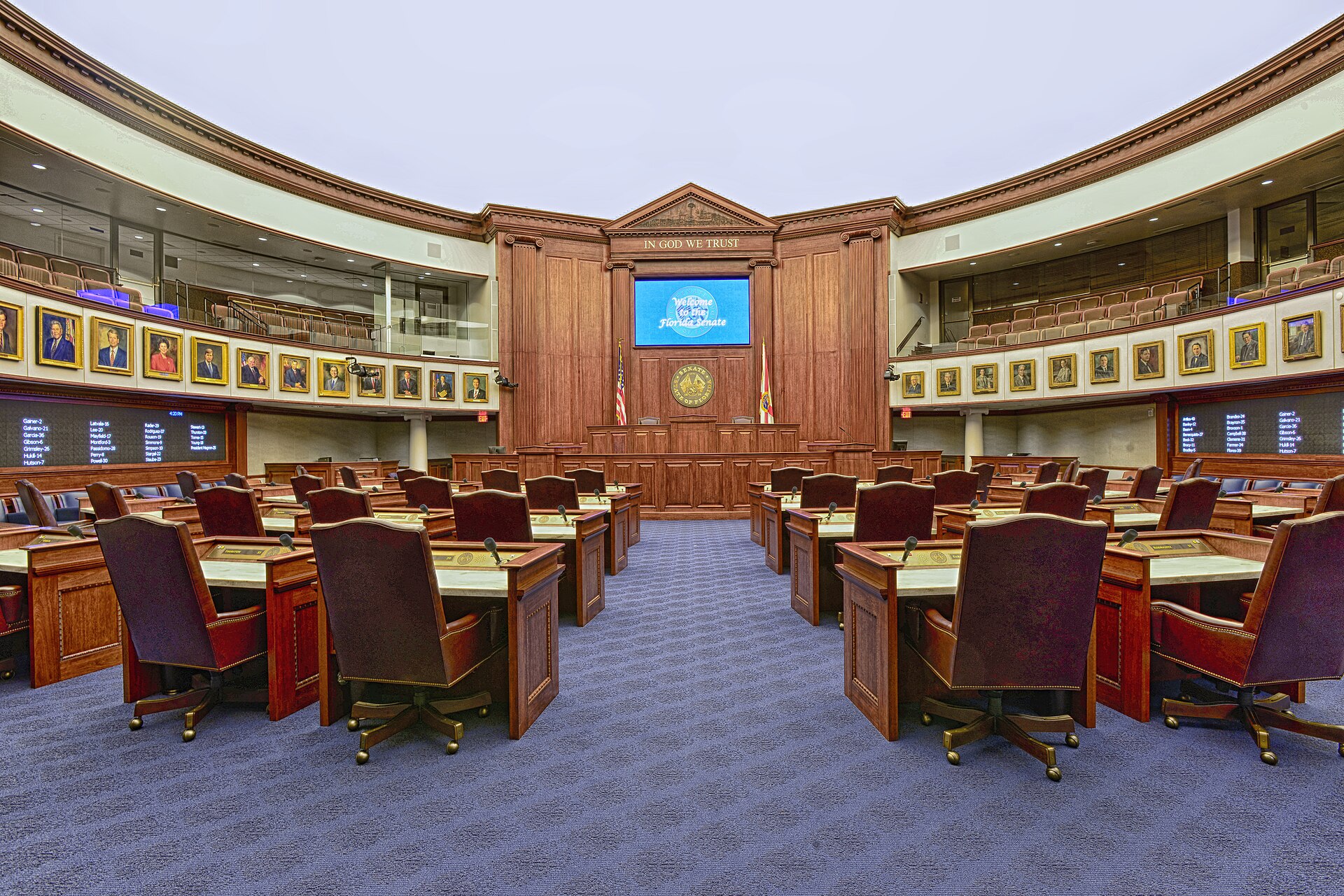
This article reflects information available as of November 2026 and is not legal advice. AHCA’s rules are still in draft and may change. Photo: the Florida Senate chamber in Tallahassee, by the Florida Senate (public domain), via Wikimedia Commons.
Have questions about memory care for someone you love? Call Generations Senior Living at (352) 474-2696 or schedule a tour of one of our three homes near The Villages.